
Older Canadians are having more sex—and it’s really good. So why does it bother us so much? Postmedia Healthing
“Those core needs for closeness and human contact that everybody has doesn’t go away as people become older.” Postmedia Healthing explores the stigma surrounding senior sex, and Dr Rosen weighs in Click here to read more
Infographic – What’s being left under the covers?
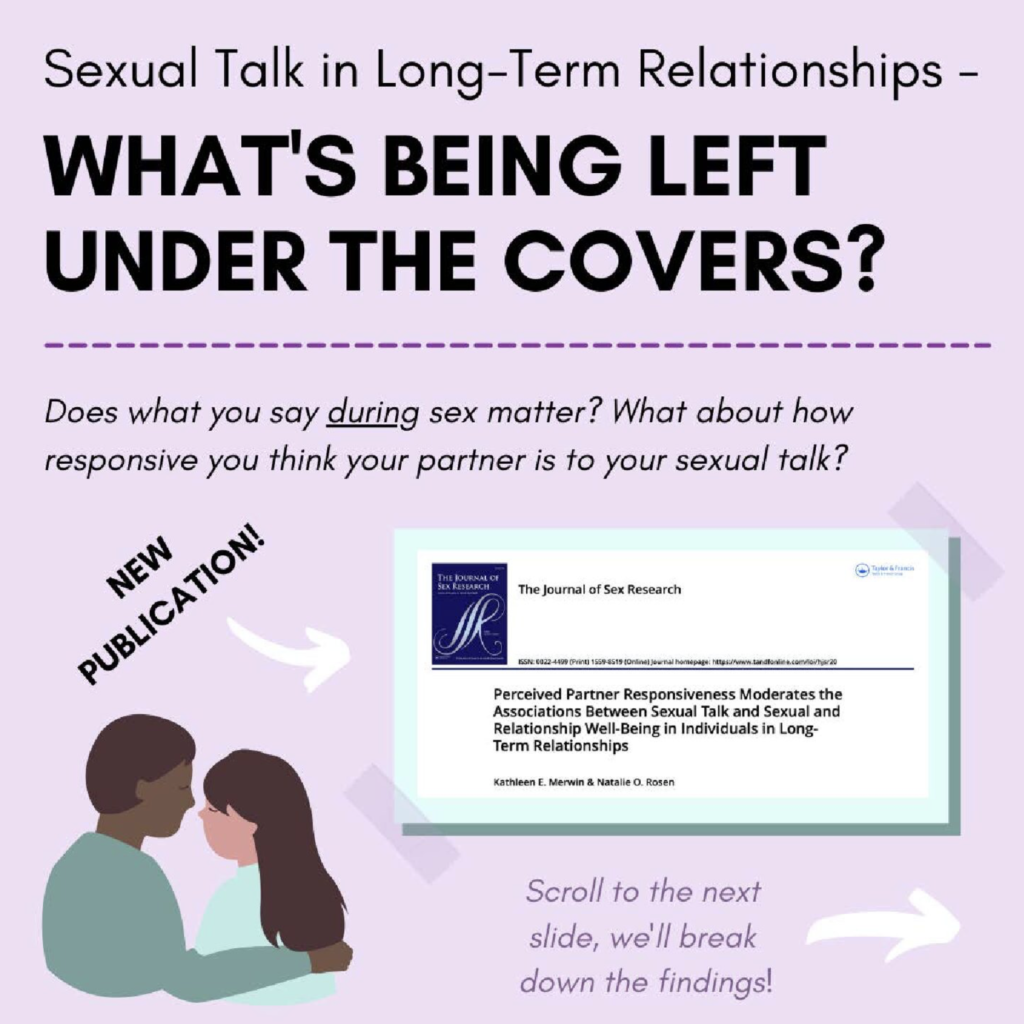
Click here for the full document! Enjoy an infographic summarizing our paper. Merwin, K. E., & Rosen, N. O. (2019). Perceived partner responsiveness moderates the associations between sexual talk and sexual and relationship well-being in long-term couples. The Journal of Sex Research. doi:10.1080/00224499.2019.1610151 Infographic by Eva Cohen
Tips from a sex therapist (Episode 89), Sex and Psychology Podcast with Justin Lehmiller
Dr. Lehmiller interviews Dr Rosen about what she thinks couples should know, from the perspective of a practicing sex therapist Click here to listen
Navigating Sex During Pregnancy and Parenthood (Episode 88), Sex and Psychology Podcast with Justin Lehmiller
Dr Lehmiller of Sex and Psychology interviews Dr Rosen Click her to listen
Dr Rosen’s Interview for Mama Sex Book
Dr. Rosen talks to the Mama Sex Six about postpartum sexuality Click here to read more
Charlene Belu, PhD

Dr. Charlene Belu joined the CaSH lab as a SSHRC Postdoctoral Fellow in 2022, after completing her PhD in Clinical Psychology at the University of New Brunswick. She completed her predoctoral residency at the Royal Ottawa Mental Health Centre. Charlene has broad interests in sexuality and her research program examines the formation, maintenance, and breakup of romantic relationships, […]
Grace Wang

I am a Clinical Psychology PhD student and I am so excited to be part of the Dal community and the CaSH lab! I lived in Vancouver, British Columbia and San Francisco, California before pursuing a psychology specialist degree at the University of Toronto. This is where I not only began to really love research, but […]
Depressed and distressed? Changes in new parents’ depressive symptoms and sexual concerns over time

By David B. Allsop; This blog is a summary of our published article: Dawson, S. J., Strickland, N. J., & Rosen, N. O. (2020). Longitudinal associations between depressive symptoms and sexual concerns among first-time parent couples during the transition to parenthood. The Journal of Sex Research. DOI: 10.1080/00224499.2020.1836114
Don’t hesitate, just regulate: Emotion regulation and women’s sexual well-being

By Justin Dube; This blog is a summary of our published article: Dubé, J. P., Dawson, S. J., & Rosen, N. O. (2020). Emotion Regulation and Sexual Well-being Among Women: Current Status and Future Directions. Current Sexual Health Reports, 1-10. https://doi.org/10.1007/s11930-020-00261-9
What is technology-facilitated sexual violence?

By Vasileia Karasavva With the surge in online access, technology has seemingly completely infiltrated our lives and has fundamentally changed the ways we interact with each other. Part of this change is for the better: along with the internet, we got cat memes, streaming services, and knowledge at our fingertips. Digital communication may also have […]
